
Troubleshooting Common Cranial Concerns
Skin
Skin irritation is one of the most common concerns with helmet treatment.
Your baby may have:
- increased sweating
- mild pinkness or other discoloration
- temporary pressure marks
- heat rash
- irritation from friction
- irritation related to cleaning products
- less commonly, a fungal or bacterial infection
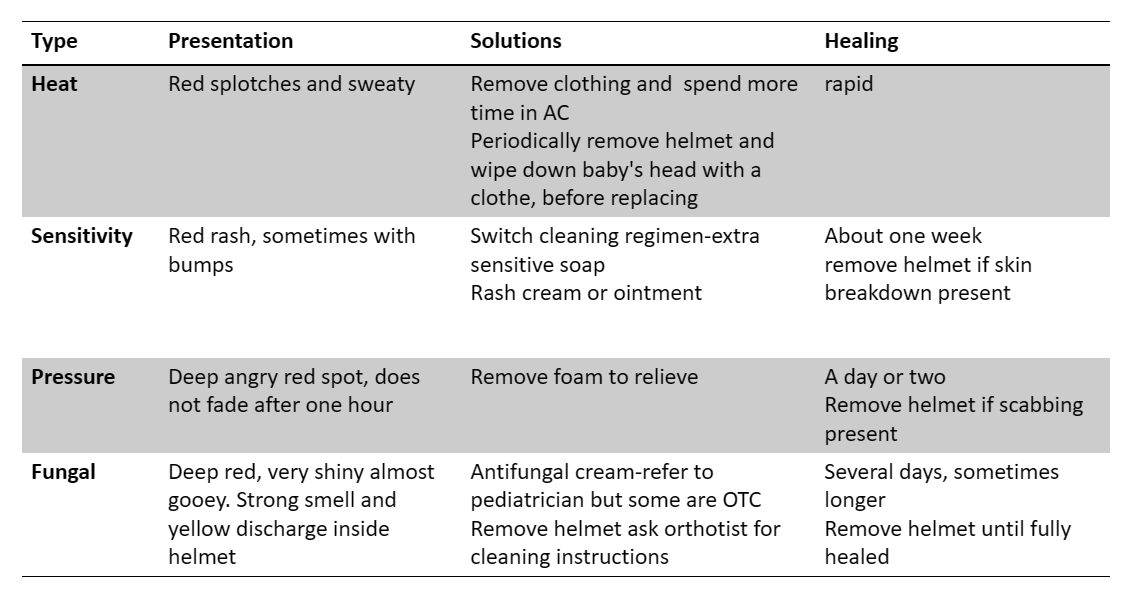
Read the skin concern table as text
| Type | Presentation | Solutions | Healing |
|---|---|---|---|
| Heat | Red splotches and sweaty | Remove clothing and spend more time in AC Periodically remove helmet and wipe down baby's head with a clothe, before replacing | rapid |
| Sensitivity | Red rash, sometimes with bumps | Switch cleaning regimen-extra sensitive soap Rash cream or ointment | About one week remove helmet if skin breakdown present |
| Pressure | Deep angry red spot, does not fade after one hour | Remove foam to relieve | A day or two Remove helmet if scabbing present |
| Fungal | Deep red, very shiny almost gooey. Strong smell and yellow discharge inside helmet | Antifungal cream-refer to pediatrician but some are OTC Remove helmet ask orthotist for cleaning instructions | Several days, sometimes longer Remove helmet until fully healed |
If you notice redness or darkened skin that does not fade after 60 minutes—Remove the helmet and report to your orthotist. Persistent pressure areas can indicate a problem with fit and should be evaluated rather than ignored (Gump et al., 2013; Steinberg et al., 2015).
Good hygiene, appropriate helmet fit, and regular follow-up can help prevent or manage many skin complications associated with helmet therapy (Gump et al., 2013; Wilbrand et al., 2012).
Sleep
Most CROs are designed to be worn during sleep as well as during the day. Some babies need time to adjust to sleeping in the helmet. The helmet should not be removed simply because your baby is sleeping unless your orthotist or physician has specifically instructed you to do so.
Regardless of helmet treatment, continue to follow safe-sleep recommendations: place your baby on their back for sleep on a firm, flat, noninclined sleep surface without loose bedding or soft objects (Moon et al., 2022).
Crying
Some babies fuss when they first begin wearing a CRO. This may reflect the unfamiliar sensation, warmth, sweating, or simply the process of getting used to the helmet.
Most babies adapt to wearing the CRO within a few days, although individual experiences vary.
Persistent crying, obvious discomfort, or a sudden change in behavior should not simply be assumed to be “normal helmet adjustment.” The helmet should be checked for pressure, fit, and skin problems by the treating orthotist.
Rotating or Tipping
A properly fitted helmet should remain reasonably stable on your baby's head. Some movement can occur, especially as your baby grows, but excessive rotation or tipping may indicate a fit issue.
Rotation can be more noticeable in infants with plagiocephaly because the head is asymmetrical. Tipping can occur with brachycephaly because of the different shape and distribution of contact around the head. Properly designed trimlines, contact areas, relief areas, and adjustments are used to help maintain an appropriate fit (Clarren et al., 1979; Tamber et al., 2016).
Your orthotist can address fit problems by adjusting padding, contact areas, cheek extensions, neck clearance, or other portions of the orthosis.
Do not add padding or modify the helmet yourself unless your orthotist tells you to.